Monday, February 29, 2016

Seamus Cullen


Seamus Cullen (b. New York City, 15 November 1921; d. Ireland, 27 November 2005)

**Update 3/3/18: A special thanks to Alex Falcone for sharing information about Cullen which he got from Cullen's friend Herbie Brennan, and with which I'm able to update this entry.**

Seamus Cullen in 1970
“Seamus Cullen” was a pseudonym for an American, long resident in Ireland. His real name was James Serwer; he was known familiarly as Jim. He was the son of Harry Serwer (1891-1962), who worked in advertising.  Little is known about his life. 

Cullen’s birth-year appeared in Library of Congress cataloguing information as 1927, but this is erroneous (the correct year being 1921). The dust-wrapper blurb for his first (mainstream) novel, Walk Away Slowly (1970), which is described by the publisher as “a novel about an obsessive love,” divulges more details about his life than perhaps any other published source.  It reads:

Seamus Cullen, onetime photographer and classical guitar player, spent his early childhood mostly in New York City and the west of Ireland. Now he seems settled in Dublin, but travels constantly as a marketing and management consultant to business firms all over Europe. After the war he did a stint for the Civil Air Patrol in the United States Naval Air Service and professes to “still find flying fun, skiing, water skiing, just being in the country.” He is also “rather busy bringing up a twelve-year-old daughter single-handedly. Married twice and extremely cautious.”

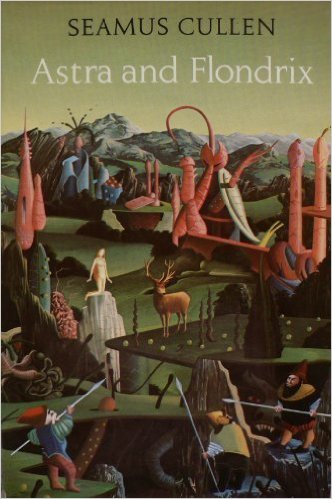
Cullen is best-known for the second of his four novels, the bizarrely twisted and erotic Astra and Flondrix (London: Allen Lane, 1976; New York: Pantheon Books, [1977]), in which the naïve Flondrix, the offspring of a sexual transgression between the mortal Dark King and an Elvan princess, journeys around in a world where every orifice is open to every form of eccentric genitalia, in terms of shape, size, color, etc. The plot itself is minimal, and the unending sexual escapades are the basis for the narrative’s forward movement. According to fellow fantasist Herbie Brennan (whom Cullen came to know in Ireland), the manuscript was originally titled Enter Prefix, and while Cullen was apparently somewhat insecure about the book, Brennan loved it and encouraged him to send it out for publication.  After a few refusals, it was accepted by Allen Lane, and renamed (at the publisher's behest) Astra and Flondrix. It was modestly successful, and was translated into Danish, Dutch and Swedish.

Cullen wrote a sequel, which Brennan thinks was titled The Beast Beneath, but the editors at Allen Lane responsible for accepting and publishing Astra and Flondrix had left the firm, and the book was declined.

Cullen also published in England two Arabian-styled fantasies, A Noose of Light (1986) and The Sultan’s Turret (1986); they have had no U.S. editions. An extensively revised episode from the second of these novels appeared in Mike Ashley’s The Mammoth Book of Seriously Comic Fantasy (1999; US title, The Mammoth Book of Comic Fantasy II), following an Arthurian tale, “Meraugis and Medwina,” which had appeared in Ashley’s The Chronicles of the Round Table (1997).

In May 2006, a query from Mike Ashley to Cullen was returned and marked “deceased.”  A further query with the post office in Kilmacanogue, where Cullen lived just to the south of Dublin, revealed that Cullen had been very ill with cancer, and had moved to a neighboring village the year before. According to Herbie Brennan, Cullen died of brain cancer, not long after his eighty-fourth birthday.


Wednesday, February 3, 2016

L.H. Allen


L.H. Allen (b. Maryborough, Victoria, Australia, 21 June 1879; d. Moruya, New South Wales, Australia, 5 or 6 January 1964)

Leslie Holdsworth Allen was the son of the Reverend William Allen (1847-1919) and his wife Martha Jane Holdsworth.  William Allen had been born in England but immigrated to Australia with his family when young, later becoming well-known as Congregational Minister of Melbourne and Petersham, N.S.W. Leslie was the second of five or six children, and was educated at Newington College, Sydney, Sydney University (B.A. 1904), and Leipzig University (Ph.D. 1907). He spent most of his life in Australian academia, at the Royal Military College at Duntroon from 1918 to 1930, and at Canberra University College (now the Australian National University) from 1931 on. He married Dora Bain (1880-1932) in Chatswood on 22 December 1915. They had two children, one daughter, and one son who died young.   

His first book was Gods and Wood-Things (Sydney: Angus & Robertson, 1913), which is a collection of seven poems and seven Hellenistic vignettes of fauns, centaurs and naiads. He translated two of Friedrich Hebbel’s Three Plays (1914) for the Everyman’s Library. Further poems were collected in Phaedra and Other Poems (London, 1921), Araby and Other Poems (Sydney, 1924) and Patria (Melbourne, 1941). 

Wednesday, January 27, 2016

Tom Ingram


Tom Ingram (b. Spaxton, England, 26 July 1924; d. reg. Bath, England, January 2007)

Thomas Henry Ingram was the son of John Markham Ingram, an officer in the armed forces, and his wife Grace Williams.  He served in the Royal Artillery of the British Army from 1942-45, and was educated at Corpus Christi College, Cambridge (B.A. 1948; M.A. 1957).  He worked for a few years as a teacher, and for several subsequent years as a researcher and writer, before lecturing in the United States for the Netherlands Office of Overseas Students in 1957-58, and as an instructor (1958-60) and assistant professor of English (1964-65) at Long Island University. Returning to England he held positions at the City of Bath Technical College (1960-64; 1965-67) and the British Polytechnic, West England College of Art (from 1967).  He married Marie Robbins-Vona in April 1958; they had three children, two daughters and one son.

All his books are published as by “Tom Ingram.” His first, Bells in England (1954), is nonfiction, and it includes two appendices written for the book by Robert Aickman, on Henry Irving in “The Bells” (five pages) and “The Bells of Bealings House” (also five pages). With Douglas Newton he compiled Hymns as Poetry (1955), and Banns of Marriage (1955) was his first novel.

Ingram turned to writing juveniles in the 1970s, and the first of these, The Hungry Cloud (1971; retitled Garranane in the 1972 U.S. edition), is a compelling fantasy (with excellent illustrations by Bill Geldart) of an evil lady named Fenrir who can destroy a person by drawing a likeness, threatening Kai and his sister Flor as well as their entire kingdom. It was followed by two other juveniles, The Night Rider (1975), a time-slip fantasy, and The Outcasts (1977), where in response to murderous attacks by eagles on a village, three people are driven away. 
UK dw
US dw
UK dw
US dw
UK dw (no US edition)


Monday, January 25, 2016

Darrel Crombie


Darrel Crombie (b. New Glasgow, Nova Scotia, 1915; d. New Glasgow, Nova Scotia, 2001)

“Darrel Crombie” was the pseudonym of Joseph Fraser Darby, the son of Joseph Edwin Darby (1882-1965), a British-born Canadian accountant, and his wife, a school-teacher, Marion Louise Fraser (1883-1965), who were married in New Glasgow on 4 September 1914.

Darby, as “Darrel Crombie,” published very little, but small-press publisher Donald M. Grant thought very highly of him.  Grant published his only-known short story, “Wings of Y’vren” in the anonymously-edited paperback anthology, Swordsmen and Supermen (1972).  A short essay titled “Ghosts Walk . . .” is a memoir of Darby reading Talbot Mundy as a youth.  It appeared in Grant’s Talbot Mundy: Messenger of Destiny (1983). 

According to Grant, Darby studied writing for more than two years in the mid to late 1930s via a correspondence course with Arthur Sullivant Hoffmann (1876-1966), who had been the editor of Adventure during its glory years 1912-1927.  Grant also notes that Darby “began to crack the British market with poetry and fiction. But World War II rolled around, and a hopeful start was erased in a day.” Darby gave up writing creatively for more than twenty-five years (though he worked for years as a journalist).  Through the late 1960s and early 1970s he worked on a trilogy to be titled The Priestess of the Silver Star, but he never finished it.  In the mid-1970s, after Grant was shown an unpublished El Borak story by Robert E. Howard titled “Three-Bladed Doom,” he passed it on to Crombie for re-writing.  Crombie reworked this into a 102 page typescript under the title of “Lair of the Hidden Ones,” but again he never finished it. 

Darby’s pen-name took the “Dar” from his last name, expanding it to Darrel, and Crombie came from his summer home in Abercrombie, just outside of New Glasgow in Nova Scotia. 

*I’m grateful to Nagzie Harb of Nova Scotia for supplying some information on Darby.

Wednesday, January 20, 2016

L.A. Lewis


L. A. Lewis (b. Sheffield, England, 6 February 1899; d. Southall, England, 28 October 1961)

Leslie Allin Lewis was the only child of Arthur Henry Lewis (b. 1872), a brewery expert according to the 1911 UK Census, and Catharine (sometimes Catherine) Mary Ann Allin (1870-1962), who were married at Wantage, Berkshire, in the spring of 1896. 

Leslie grew up at the Allin family estate at East Hendred in Berkshire, and was educated at Roysse’s School in Abingdon (now named Abingdon School).  As a boy he wrote and illustrated a series of stories about a panther named Blackie. During World War I he joined the Artist’s Rifles, and trained as a pilot, taking his certificate on the Maurice Farman Biplane at the Military School in Ruislip, on 29 May 1917. According to Richard Dalby, he served in France for a year, and after the war he took a course in Aero Engineering, and later earned an Instructor’s license. 

His father apparently died before 1925, and after 1926 Leslie lived with his mother and some members of her family in the Finchley area of London, through around 1951, save for a time of service in the R.A.F. during the World War II.  In July 1929, he published a story “The Chords of Chaos” in The Theosophist, edited by Annie Besant. His one collection of ten stories, Tales of the Grotesque (London: Philip Allan), came out as part of the “Creeps” series in October 1934. It is one of the best of the volumes of the “Creeps” series, with original tales like “The Tower of Moab” in which a man’s madness is exemplified by his vision of a Babel-like tower. One later tale, “The Author’s Tale,” came out in Terror by Night (1935), edited by Christine Campbell Thomson as part of the “Not at Night” series.

Elizabeth Yeardye Rickell (1897-1988), who had served in Queen Mary’s Army Auxiliary Crops during World War I, was Leslie’s longtime friend, and she apparently became his common law wife in the early 1950s (there is no official record of their marriage).  She told Richard Dalby that her husband destroyed his surviving writings in a fit of depression, and that he long suffered from hallucinations, and from deteriorating physical and mental health during his final years. He died of a heart attack while in hospital in 1961.  Tales of the Grotesque has been reprinted three times, expanded by the one uncollected tale, in hardcover by Ghost Story Press in 1994 and 2003, and in trade paperback by Shadow Publishing in 2014, each reprint having an introduction by Richard Dalby.