Wednesday, October 17, 2012

Henry Iliowizi


Henry Iliowizi (b. Choinick, near Minsk, Russia, 2 January 1850; d. Edmonton, Middlesex, England, April 1911)

Henry Iliowizi was born in a Hasidic community in southern Russia, the son of Elijah and Dinah Iliowizi. When he was fourteen, he was sent to Romania in order to escape military conscription. He studied in Frankfort-on-the-Main, Berlin, Breslau, London and Paris, and from 1877 to 1880 taught at the Alliance School in Tetouan, Morocco. Having become a Rabbi, he immigrated to the United States in July 1880, ministering for a brief time a congregation in Harrisonburg, Virginia, before settling in Minneapolis, where he was Rabbi of the Congregation of Sha’aré Tob. Around 1881 he married Mathilde Flesch (1858-1917), who was born in Bavaria and who had come to the U.S. in 1871.  The couple had no children.  They lived in Minneapolis until 1888, when Henry became Rabbi of the Congregations Adath Jeshurun in Philadelphia, a position which he held until 1900, after which time he devoted himself exclusively to literature. Around 1910, the Iliowizis moved to England, where Henry soon died at the age of 61.  Mathilde, who still retained U.S. Citizenship, died of cancer in Munich, aged 59.

In addition to his religious work, Iliowizi clearly had high literary ambitions.  His first book was Sol: An Epic Poem (1883), followed soon after by Herod: A Tragedy (1884), a drama in five acts.  Other epic poems and dramas include Joseph: A Dramatic Representation in Seven Tableau (1885), The Quest of Columbus: A Memorial Poem in Twelve Books (1892), Saul: A Tragedy in Five Acts (1894), and the book-length poem, Revelation: Worlds Mystic and Realistic (1910). He published one memoir, Through Morocco to Minnesota: Sketches of Life in Three Continents (1888), and one novel, The Archierey of Samara: A Semi-Historic Romance of Russian Life (1903), as well as some religious writings, including Jewish Dreams and Realities: Contrasted with Islamitic and Christian Claims (1890).

Iliowizi also published two collections of stories, both of which, to varying degrees, have some relevance to fantasy literature.  The first, In the Pale: Stories and Legends of the Russian Jews (Philadelphia: Jewish Publication Society of America, 1897), contains seven stories. In a brief statement published in Book News (Philadelphia), July 1897, Iliowizi wrote “The purpose of my writing In the Pale was to familiarize the English-speaking public with the legendary, romantic and spiritual aspects of life in Russian Jewry; also to convey an idea of the folklore current among the oppressed millions of Jews in the Czar’s domains. Another work in preparation is intended to complete the picture of reality and dream-life in those regions of semi-barbarism and intolerance.” (The work referred to in the final sentence is probably the novel, The Archierey of Samara.)  

Iliowizi’s second collection of stories is the more pertinent, The Weird Orient: Nine Mystic Tales (Philadelphia: Henry T. Coates and Co., 1900).  These legends were gathered from Arabic and Persian sources while Iliowizi was teaching in Morocco.  The first story, “The Doom of Al Zameri”, tells of the ancient Wandering Jew.  In another, “The Gods in Exile”, a character has a vision of the gods of Asgard encountering the Olympians.  In “The Mystery of the Damnavant”, Firdusi ascends Persia’s most graceful mountain and has a mystical vision caused by the smoke of a mysterious herb. The tales are redolent in some ways of The Arabian Nights, but with added spiritual dimensions. The Weird Orient has four inserted illustrations by William Sherman Potts.  

Iliowizi published many articles in The Jewish Messenger and in The Jewish Exponent.  One uncollected story, “Hamza’s Tale: A Folk-lore Tale of Islam”, appeared in Harper’s Monthly Magazine for May 1901. 

Saturday, October 13, 2012

Margaret Armour


Margaret Armour  (b. Abercorn, West Lothian, Scotland, 10 September 1860; d. Edinburgh, 13 October 1943)

Margaret Armour was the third child and first daughter of Alexander Henderson Harry Armour (1825-1879) and Christina Stewart (1828-c.1890s), who were married at St. Ninians, Stirling, Scotland on 2 September 1855.  She had two older brothers, and two younger sisters. She was educated in Edinburgh, Munich and Paris. She married William Brown MacDougall (1868-1936) in a civil ceremony in Glasgow on 11 May 1895, and a church ceremony followed at Morningside Parish Church in Edinburgh on 8 October 1895.  

The Eerie Book, first edition 1898
Margaret was a poet, novelist and translator. Her first book was The Home and Early Haunts of Robert Louis Stevenson (1895), which she followed with some books of poetry, Songs of Love and Death (1896), Thames Sonnets and Semblances (1897),  and The Shadow of Love and Other Poems (1898).  A novel, Agnes of Edinburgh, appeared in 1910, and she translated the poetry of Heinrich Heine for the final three volumes of the twelve volume set of The Works of Heine, published between 1892 and 1905. Her translation from the Middle High German of the Nibelungenlied into what she called “plain prose” first appeared as The Fall of the Nibelungs (1897).  It was later included in the Everyman’s Library, with subsequent editions retitled as The Nibelungenlied.  Similarly, her translation of Gudrun, which was published in 1928, also appeared in the Everyman’s Library. Along a similar vein of interest, in 1910 she translated Richard Wagner’s The Ring of the Nibelung 

First edition, later binding
Margaret’s husband, an etcher, engraver and illustrator, was frequently involved with her books, signing his work as W. Brown MacDougall or W.B. MacDougall.  He was educated at the Glasgow Academy and in Paris, and in the mid-1890s he contributed to The Yellow Book, The Evergreen, and The Savoy. His work is mostly symbolic, and frequently somber. It sometimes has echoes of Aubrey Beardsley, but MacDougall never matched Beardsley’s height of execution. MacDougall provided a frontispiece illustration of Robert Louis Stevenson for his wife’s first book, and illustrated her poetry volumes and the translations from medieval German.

MacDougall also illustrated Margaret Armour’s one anthology, The Eerie Book (London: J. Shiells and Co., 1898), which contains works by Edgar Allan Poe, Hans Christian Andersen, George W.M. Reynolds, Catherine Crowe, and extracts from works by Mary Shelley, Friedrich de la Motte Fouqué and Thomas De Quincey. To the modern reader this compilation is dated and unsatisfactory, though at the time of publication it may have broken new ground.  The dozen and a half illustrations (including the cover) range from the truly crude to the competent (see below).  One of the illustrations in particular evokes Beardsley.  

Around the turn of the century, Armour and MacDougall settled in Essex, first in Chingford, and soon afterwards in Debden Green, where MacDougall died on 20 April 1938. Armour returned to Edinburgh, where she died in 1943. They had no children.
 
Illustration for "The Mother and the Dead Child" by Hans Christian Andersen

Illustration for "Earl Beardie's Game at Cards", no author given

Illustration for "Tregeagle" extracted from Robert Hunt's "Popular Romance of the West of England"  


Sunday, September 9, 2012

Sir Harold Boulton

Sir Harold Boulton (b. Charlton, Kent, 7 August 1859; d. London, 1 June 1935)


Harold Edwin Boulton was the elder son of Sir Samuel Bagster Boulton (1830-1918), the founder and chairman of the London Labour Conciliation Board whose baronetcy was created in 1905, and Sophia Louisa Cooper (1837-1900).  He had four sisters and one brother.  He was educated at Harrow, and at Balliol College, Oxford (B.A. 1881), where he was devoted to music, for some time leading the school choir.  On leaving Oxford, he joined the family firm of Burt, Boulton and Haywood, which owned timber, railway and chemical businesses. 

On 20 January 1889 he married Adelaide Lucy Davidson (1863-1926), and they had two sons (one of whom died in the Great War) and one daughter.  In 1903 he founded with his father the Dominion Tar Chemical Company in Nova Scotia, and visited Canada frequently. He succeeded to the Baronetcy on his father’s death in 1918. After his first wife’s death, he married on 26 December 1926 Margaret Cunningham Lyons (1860-1938), the widow of Robert Charles Simpson Moodie of Montreal.  Boulton was very active in business and artistic interests, particularly song-writing, as well as philanthropy. 


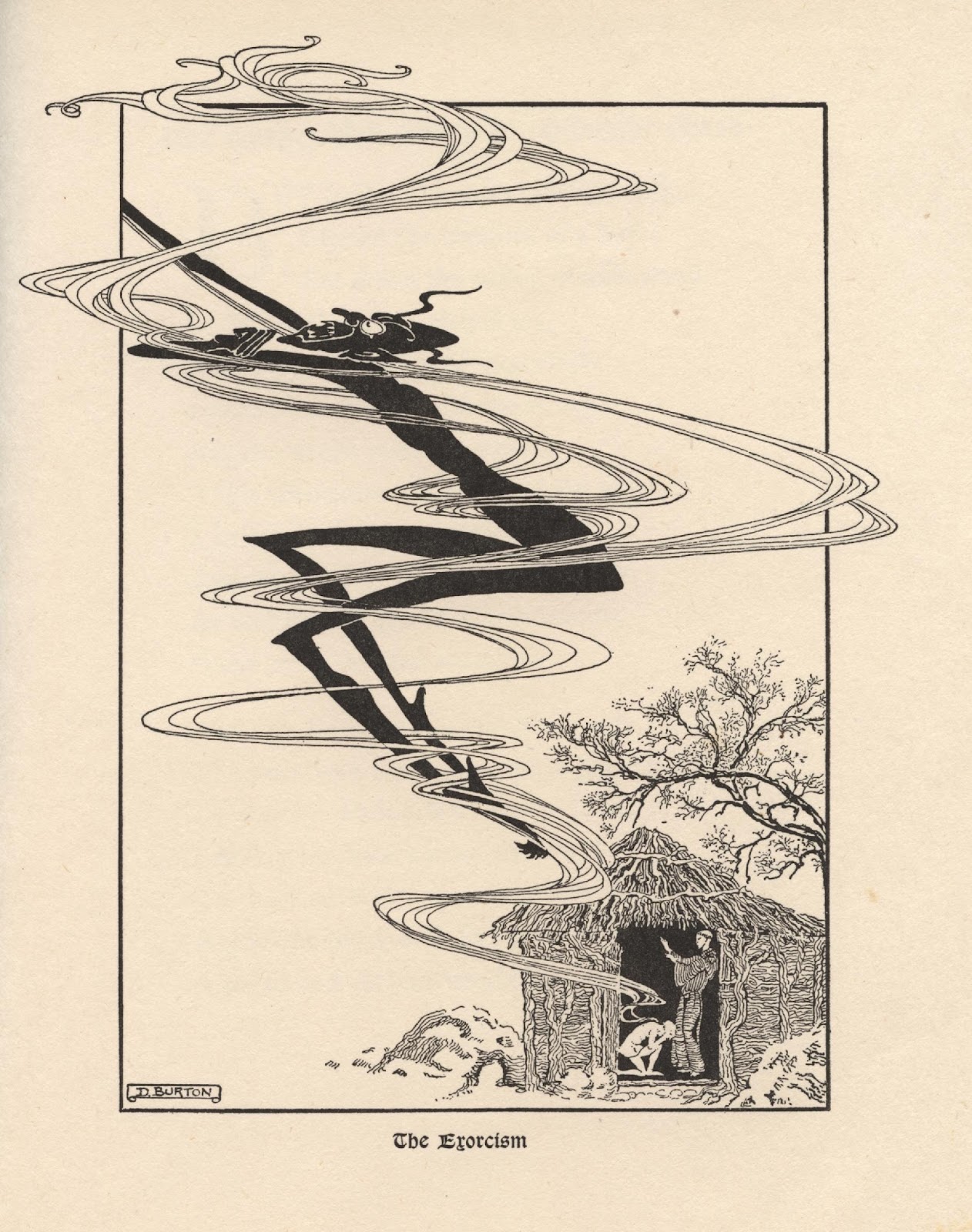
 He edited or co-edited Songs of the North: Gathered Together from the Highlands and Lowlands of Scotland (four volumes, 1880s?), Songs of the Four Nations: A Collection of Old Songs of the People of England, Scotland, Ireland and Wales (1892) and Our National Songs (three volumes,1923-31). He wrote Songs Sung and Unsung (1894), and several other slim booklets and collections. The Huntress Hag of Blackwater: A Mediaeval Romance (London: Philip Allan, 1926) is a narrative poem of romantic supernaturalism, with macabre illustrations by Doris Burton.  


Thursday, August 9, 2012

Jane Pentzer Myers

Jane Pentzer Myers (b. Germantown, Ohio, 1 April 1852; d. Iowa City, Iowa, 31 January 1917)

**revised 28 October 2024**

Jane Pentzer Myers published only one book, a collection of twelve children’s fantasies, Stories of Enchantment (Chicago: A.C. McClurg & Co., 1901), illustrated by Harriet Roosevelt Richards.  Several of the stories contain Native American elements, like “The Ghost Flower” and “The Corn Fairy”, and thus may be placed alongside similar works of the same time-period like Zauberlinda the Wise Witch (1901) by Eva Katharine Gibson and some of the stories by L. Frank Baum. Myers's narratives are skillful—one is surprised that this is her only book.  

Very little has been known of the author, and what I had published here in 2012 turned out to be incorrect. Thanks to a relative of the author, I can now re-write this entry with correct information.  

She was born Mary Jane Pentzer, though she never used her first name, and was generally known as "Jennie." Her father was Reverend Jacob Pentzer (1808-1884), her mother was Jacob's second wife, Martha Coons (1825-1913); they were apparently married in 1848. Martha Coons was the daughter of Rev. John Coons (1797-1869). Jennie had four half-siblings from her father's first marriage to Emma Meek (1812-1847); and several from her father's second marriage. The family moved from near Dayton, Ohio, to Wilton, Iowa in 1859. Jennie married John Edward Myers (1848-1898) in Wilton on 26 June 1874. The couple moved to Iowa City, where they had three sons, the second of whom died in infancy. Jennie was known as a gifted musician, but around the age of forty, she became invalided by rheumatism, and then she took up writing, reportedly contributing to many magazines (none of these writings have been traced). Her only book was published for the Christmas season in 1901. It was dedicated to her niece. After she was widowed, Jennie lived for a while in Muscatine, where one of her sons taught in the high school. She moved back to Iowa City around 1908, dying at her home, in the early morning of 31 January 1917, of complications of diseases.

 
*This entry was revised and updated on 10 October 2012; again on 15 January 2019; and again on 28 October 2024. I am grateful to Julie (Pentzer) Olson for the information presented here.

Tuesday, July 3, 2012

Robert Nelson


Robert Nelson (b. St. Charles, Illinois, 23 July 1912; d. Elgin, Illinois, 22 July 1935)

Sable Revery: Poems, Sketches, Letters
Robert William Nelson was the only child of Elmer Nelson (1884-1978) and Ella Larson Nelson (1889-1974), who had both emigrated from Sweden in 1908. They married in 1911. After Robert graduated from the St. Charles High School in 1930, he spent one year at an Illinois university, and also studied journalism in a night class at Northwestern University. Nelson’s engagement with fandom is evidenced by his first letter (of five) in “The Eyrie”, the news and letter-column of Weird Tales, in the issue dated April-May 1931. From then until his death four years later he regularly appeared in letter columns and fanzines. His first poems appeared in 1934, “Below the Phosphor” in The Fantasy Fan for June and “Sable Revery”, in Weird Tales for September 1934. He corresponded with H.P. Love craft and Clark Ashton Smith. In early July 1935, he suffered a nervous breakdown, and seems to have attempted suicide. Though there was hope for his recovery, he died in the hospital in Elgin on 22 July 1935, one day short of his twenty-third birthday.  A collection of all his published writings, Sable Revery: Poems, Sketches, Letters, with an introduction by Douglas A. Anderson, appeared in 2012.  It also includes as an appendix five letters from H.P. Lovecraft, four to Nelson and one to Nelson’s mother after her son’s death. In it, Lovecraft wrote:
“His promise in the field of literature seemed to me very considerable; for despite the marks of youthful construction—indefiniteness or overcolouring now and then—his work had a distinct imaginative richness and atmospheric power which was rapidly improving through criticism and self-discipline. I expected to see him develop like other youths whose careers I have watched—August W. Derleth, Donald Wandrei, Frank B. Long, etc.—who are now well-established figures in the world of weird writing.”
The Nelson family gravestone, Union Cemetery, St. Charles, Illinois


Monday, June 4, 2012

S. Matthewman


S. Matthewman (b. Leeds, 18 January 1902; d. reg. Surrey, July-Sep. 1970)

**updated 7 January 2016; 6 October 2025**
Sydney Matthewman*

Sydney Matthewman was the only child  (per the 1911 UK Census) of John Matthewman (1879-1946), a printer, and Matilda Wardman (1878-1965), who were married in Leeds in the spring of 1901.  He was educated at the Leeds Modern School, and the University of Leeds.  Throughout the 1920s Matthewman was especially associated with the poetry scene in Leeds, as well as in London.  He was the founder and editor of Yorkshire Poetry from 1922-24, while also the associate editor of Poetry Review (1921-23) and assistant editor of The Decachord from 1923-29.

In 1921 Matthewman began to produce booklets of poetry out of his father’s printing business in Swan Street, calling his imprint The Swan Press. His first book was a small pamphlet of his own poems, together with a verse dialogue, entitled The Gardens of Meditation (1921). Within a few years he proceeded on to more substantial works by friends and others with whom he had come into contact at Leeds University.  Besides publishing his own writings (all as “S. Matthewman”), the Swan Press also published collections by Catholic poet and Leeds professor Wilfred Rowland Childe (1890-1952), and anthologies like A Northern Venture: Verses by Members of the Leeds University English School Association (1923) and Leeds University Verse: 1914-1924 (1924), which include poems by J.R.R. Tolkien, then also on the faculty at Leeds. Many of the Swan Press books were published in small editions. The first printing of A Northern Venture, published in June 1923, was a mere 170 copies, and the reprint in July was of another 200 copies. This title was an exception, for most of the Swan Press booklets were not reprinted at all. 

Decoration by Albert Wainwright,
for The Crystal Casket
Most of Matthewman’s own small books were published between 1921 and 1930.  These include poetry, The Lute of Darkness (1922), Two Poems of the Road (1924), Six Epigrams (1924), The Harlequin (1925), Poems 1927 (1927), Orchard Idyll (1927), Strange Garden (1928), Epithalamion: An Ode (1929); a small essay collection, Sketches in Sunshine (1926); and a few prose fantasies, The Crystal Casket (1924), and The Vision of Richard concerning the Chapel of the Sword and the Rose (1926). The Crystal Casket is a short original fairy tale of merit. A third prose fantasy is How Brother Theodosius Beheld a Vision: A Little Tale of the Springtime (1928), printed privately in an edition of fifty-seven copies. In an entry for a writer’s directory, Matthewman listed a few further titles that cannot presently be verified, including Interlude (1929), as well as some planned translations: Plum Blossom and Nightingale from the Japanese, The Rubai yat of Sarmad (with B. Ahmed Kashmi), and The Complete Poems of Meleager. None of these seem to have been been published.  For High House Press in Shaftesbury, Matthewman translated Hylas: The XIIIth Idyll of Theokritos (1929), and wrote The High House Press: A Short History and an Appreciation (1930). Four Country Poems (1932) came out from Red Lion Press in an edition of fifty copies. Many of Matthewman’s books have decorations by Albert Wainwright (1898-1943).

Matthewman's bookplate (courtesy of Shane Taylor), using Laurence Housman's frontispiece to his collection The Field of Clover (1898), engraved by his sister Clemence Housman

Matthewman served as secretary to various scientific societies, and joined the Leeds Civic Playhouse in 1927.  He played the part of Hannan in the first British production of The Dybbuk by S. Ansky (1863-1920). Matthewman married Phyllis Barton (1896-1979) on 22 February 1930.  They had no children and moved around frequently, and sometime in the 1930s Sydney had some sort of breakdown.  Phyllis Matthewman took up writing with Chloe Takes Control (1940), published by the Girls Own Paper Office in London.  Over the next three decades, she would publish over seventy books, most of them novels, many of them published by Mills & Boon. In the mid-1940s she published two novels under the pseudonym Kathryn Surrey. Her final books appeared in 1974.

In 1944, Sydney and Phyllis took temporary refuge from the bombings around their home in Surrey by removing to Hereford, where they became close friends of the writer Elinor Brent-Dyer (1894-1969), author of the popular “Chalet School” series for girls.  Phyllis and Brent-Dyer had known each other as children, but hadn’t been especially close. 

In 1946, after a long hiatus, Sydney published two small books of poetry, Gabriel’s Hounds, a tale in verse, and Christmas Poems. He also served as editor for The Bookmart in 1946-47. 

In 1949, when Sydney set up a literary agency, Elinor Brent-Dyer became one of his first clients.  In 1964, the Matthewmans and Brent-Dyer purchased a house in Redhill, Surrey, where the Matthewmans lived on the ground floor and Brent-Dyer occupied the upstairs flat.  Local residents in Redhill recall Sydney Matthewman as a tall man, around six foot three or four inches tall, who wore a monocle. Brent-Dyer died suddenly in 1969. Sydney Matthewman died the following year.  Phyllis Matthewman lived on until 1979, passing at the age of 83.

*Thanks to Michael Green for the scan of the photograph of Matthewman, the frontispiece to Poems (19 27) 

Thursday, May 31, 2012

Benson Bidwell


Benson Bidwell (b. Avon, New York, 2 September 1835; d. Chicago, Illinois, 7 March 1911)

Benson Bidwell published only two books, both coming out at his own expense in 1907.  The first is an autobiography of sorts, with the breathlessly long title Benson Bidwell: Inventor of the Trolley Car, Electric Fan and Cold Motor: History of Early Struggles and Later Successes: With Personal Reminiscences, Lectures, Essays and Letters (Chicago: The Henneberry Press, 1907).  The second is a slim epistolary fantasy, The Flying Cows of Biloxi (Chicago: The Henneberry Press, 1907). The latter book has achieved a legendary status.  According to Vincent Starrett, who wrote in 1948 in his “Books Alive” column in The Chicago Daily Tribune, “it first came to notice of fantasy collectors, in 1933, when it was listed in Science Fiction Digest and attracted attention by its provocative title. Ever since, book hunters in the fantasy field have been seeking the tale and failing to find it; it has become one of the famous ‘phantom books’ of recent bibliography” (11 April 1948). Starrett also quoted Melvin Korshak, who during the World War II had been stationed near Biloxi and one day went there and questioned the mayor and a delegation of alderman about the book:  “without result, except that I worried them considerably about a mystery book that took the name of their city in vain. They didn’t know anything about flying cows, either; and they would like to know something about Benson Bidwell, the reputed author.” A few years later, Frederick Shroyer devoted his column (“The Antiquarian Bookshelf”) in the September 1950 issue of Fantasy Advertiser to discussing the book.  Many years later, Sam Moskowitz published “A Collector’s Saga” in Fantasy Commentator, no. 45/46 (Winter 1993/1994) a long account of his search over many years to acquire a copy. Typically Moskowitz’s account centers on acquisition, not on putting any historical perspective on Bidwell or his book.

Joseph Benson Bidwell was born in upstate New York, the third child (of six) of Austin Burhham Bidwell (1804-1865), a confectioner, and Laura Isabell Butterfield, who were married in 1832.  On 3 February 1856, Bidwell married Clarissa Eliza Walker Burch (1838-1907). They had four children, two sons and two daughters. Unusually for his time, Bidwell seems to have moved around a lot.  According to the U.S. Censuses, in 1850 he and his family were living in Toledo.  In 1860 Bidwell listed himself as a baker in New York City. Ten years later he is found as a candy manufacturer in South Bend, Indiana.  By 1880, Bidwell has moved to Indianapolis, his profession elevated to that of a lawyer, while in 1900 he had evolved into an electrician in Chicago (the 1890 Census was destroyed by fire many years ago).

Bidwell first book was a self-aggrandizing autobiography in which claims are made for various inventions and episodes from his life are whipped up to the status of myth, complete with illustrations, some of which are unintentionally quite funny, having captions like “Baby Brother Petting Snake,” “He Scalds His Mother’s Foot,” “Live Indian Roasted on Logheap,” “Old Horse Resents Singeing,” etc. The legend to Bidwell’s frontispiece portrait elevates himself to the status of professor. The prose is also overblown, and the claims that Bidwell invented of the trolley car, the electric fan, and the cold motor engine, remind the modern reader of the sham hucksterism of the likes of P.T. Barnum. 

The Flying Cows of Biloxi, which is also illustrated with line drawings by the same artist, purports to collect Bidwell’s letters to a friend telling how, when visiting Biloxi, Mississippi, in 1893, Bidwell observed that the cows fed upon spanish moss, which grows only high-up in the trees.  So Bidwell invented a way to graft branches of orange trees onto the cows so they could fly up for their food.  The wings have the added advantage of growing oranges! Another great invention for the talented Bidwell!

From The Flying Cows of Biloxi

The truth is another matter.  A perusal of The Chicago Record-Herald shows that in early 1908 Bidwell and his elder son, Charles Freeman Bidwell (1857-1929), who was also his business partner, were arrested and charged with fraud and embezzlement.  Investors in his cold motor engine claimed that their money was used solely to fund the publication of his two books.  In October 1908 the pair were convicted of running a confidence game and sentenced to ten years in prison.  Charles Bidwell withdrew his appeal and accepted the prison term on the condition that his elderly and widowed father, whom he claimed was near death, could remain free.
An advertisement for the cold motor

NB: A portion of the above appeared in different form in the “Curiosities” column of the October-November 2005 issue of The Magazine of Fantasy and Science Fiction.