Sidney Stanley (b.
Clapham, London, 14 August 1890; d. Marylebone, London, 5 February 1956)
**updated January 2016; and August & September 2020**
Very little is known of the painter and illustrator Sidney
Stanley, the only child of Walter Stanley (b. c. 1858), a clerk at the Board of
Trade, and his wife Viola Agatha, née Blenman (b. in Barbados, c. 1858), who
were married in Lambeth, London, in the summer of 1889.
 |
| from The Story of Buddha |
Born Sydney
Walter Stanley (all official records give his first name as “Sydney”),
he signed his art as “Sidney Stanley”, and apparently used the spelling “Sidney” for all
non-official purposes. The 1911 UK Census shows the family in Clapham, with Sydney listed as an “art
student”. He exhibited with the Royal Academy in 1916 and 1922, and apparently
was known for painting landscapes and murals. Here I shall discuss only his
five illustrated books, plus one other
compilation in which his art appeared. In his last years he was active in the
British Astronomical Association.
His first
book he co-illustrated with Gilbert James. It was Edith Holland’s The Story of Buddha (London: Harrap, [August 1916]). It contains nine illustrations, five signed
by Stanley, three signed by James, with an unsigned frontispiece. Oddly, James is given first billing despite Stanley having
contributed more illustrations.
The next
book is perhaps his most significant in terms of his book illustrations, Serbian Fairy Tales, translated by
Madame Elodie L. Mijatovich (London: William Heinemann, 1917; New York: Robert M. McBride, 1918). It contains eight
color plates (a few particularly excellent), and eight black and white
illustrations.
 |
| from "Satan's Jugglings and God's Might" |
 |
| from "Bash-Chalek; or, True Steel" |
Stanley was one of
several illustrators to contribute to Puck
Annual 1923 (London: Amalgamated Press, 1922), and his final illustrated
books were for a series of pocket-sized classics published by Collins.
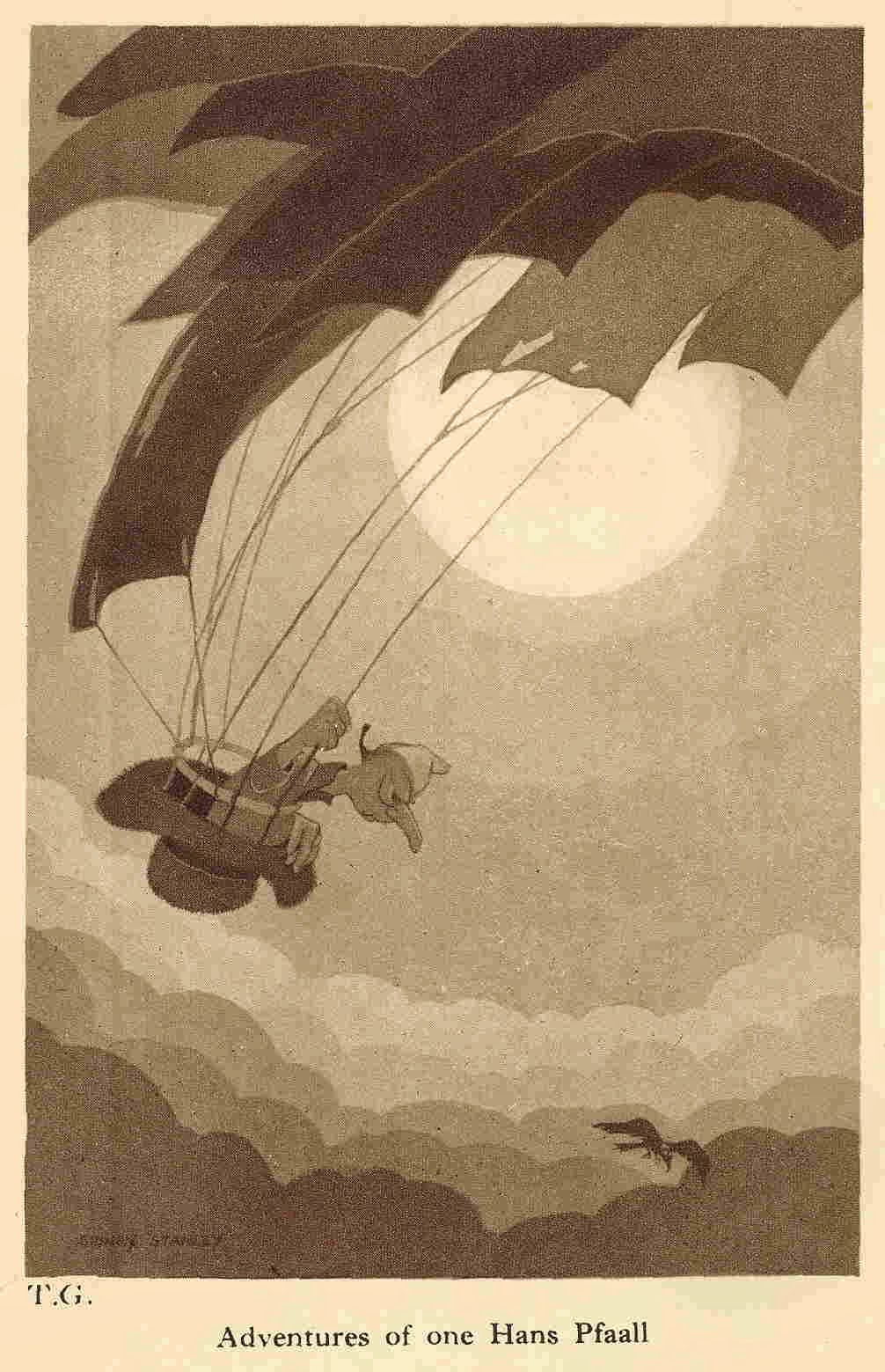
The first is Tales Grotesque (London: Collins
Clear-Type Press, [March 1931]), by E.A. Poe.It contains five plates, but reprints contain only the frontispiece (the first one below).
Stanley’s next illustrated book was The Willows
and Other Queer Tales (London: Collins Clear-Type Press, [February 1932],
by Algernon Blackwood. It contains five
plates by Stanley,
illustrating classic stories like “The Willows” (top) and “Ancient Sorceries” (second and third).
Stanley's final illustrated book was
The House with the Green Shutters (London: Collins Clear-Type Press, [March 1933],
by George Douglas. Here is the frontispiece*.
Stanley’s book
illustrations deserve much more attention than they have hitherto received.
*Thanks to Barbara Baran for supplying the four additional illustrations to the Poe volume, and for pointing out that The House with Green Shutters also appears to have five plates in its first edition, with the copies with only a frontispiece being reprints. [August & September 2020]