Sunday, April 25, 2021

Sidney Stanley: A Query

My Lesser-Known Writers entry (from 2013) on the artist Sidney Stanley (1890-1956), linked here, has attracted a good amount of attention over the years.  Recently I got a query from a person who owns four original watercolour works by Sidney Stanley. The four pictures are related, and may perhaps have been done as illustrations to a book, or to some story in some periodical. But we don't know, really, and it's entirely possible the art was never published. With permission of the owner, I am presenting one of the four here. (Click on the illustration to make it larger.)  It is titled "The Gunpowder Factory"--a related image is titled "The Firework Factory."  The other two pictures are similarly associated,  "Teapot Factory" and "The Tea Ceremony." The strange-looking figures, with long faces and long noses and a single high curl to their black hair, are common to all four illustrations. Are these supposed to be elves of some sort (even their shoes come to curled points)?  Do these ring a bell for anyone?  Comments welcomed! 


Thursday, April 22, 2021

Regina Miriam Bloch

Regina Miriam Bloch (b. Sondershausen, Thuringia, November 1888; d. London, 1 March 1938)

Regina Miriam Bloch was the youngest of three children of Jacob Bloch, a schoolmaster in Birmingham, and Henrietta Davis, a schoolmistress, who were married in Birmingham in the summer of 1875. Henrietta Davis had been born in Thuringia, where Regina was also born, though Henrietta's two previous children, a daughter and a son, were both born in Warwickshire. 

Regina was educated in Germany and in London. She started appearing in print around 1906, and she published frequently in periodicals for the next few decades, including The Academy, The IdlerThe Spectator, The Saturday Review, The Contemporary Review, The Fortnightly Review, Nash's Magazine, The Celtic Monthly, and B'Nai B'rith Magazine. She contributed to a number of anthologies, from New Songs (1907), edited by Fred G. Bowles, and The Book of the Poets' Club (1909), which includes early poetry by Ezra Pound, to The Real Jew (1925), edited by H. Newman; and some of her poetry appeared in small editions, like The Vision of the King: A Coronation Souvenir (1911).

dust-wrapper, 1917

She contributed book reviews (mostly of non-fiction) to The Occult Review from around 1914 through 1926. For a time she was the Honorary President of the Jewish Society for Psychical Research.

Her most significant books were The Confessions of Inayat Khan (1915), a study of the Indian philosopher and musician, and two volumes of short stories, most of which are mystical and decadent, and some but not all are eastern. The first collection, The Swine-Gods and Other Visions (London: John Richmond, 1917), is a slim volume containing seven stories, the most substantial of which is the title story. All appear in print for the first time save for the third tale, "The New Creation," an exemplary vision that previously appeared in The Occult Review (January 1915). There is also a Foreword by Israel Zangwill (1864-1926), a friend of Bloch's. The dust-wrapper is gorgeously designed by W. Gordon Mein (1866-1939), and the illustration on the binding derives from Mein's dust-wrapper art. It gives the feel that the book may resemble something by William Hope Hodgson, but that is not the case. The Swine-Gods was reprinted; marked as "Second impression" without a date given.

binding, 1917
Bloch's second collection is much more substantial, The Book of Strange Loves (London: John Richmond, 1918). It contains twelve main items, nine of which are stories, the other three being dramatic episodes ("not to be regarded as plays" Bloch states in her Author's Note). They are mostly romantic tales, but they range from oriental and medieval to a Breton tale, "The Leper of Vannes; An Early French Romance," to an Arthurian one, "The Garden of Meliograunce: An Early Welsh Romance." Others tell of "Samson and Delilah" and of an ancient Amazon. The Scotsman noted that "all have the same imaginative richness and unforced exaltation of feeling, and some have neat snatches of lyrical poetry in them, both graceful in itself and  in harmony with the emotional effect of the prose" (22 July 1918). The Book of Strange Loves was reprinted in 1919. 

Bloch achieved some short-lived notoriety beginning in October 1918  when an editor of the Egoist erroneously implied that Rebecca West and Regina Miriam Bloch were the same person. This mistake proliferated in the U.S. magazine Current Opinion, in September 1921, where is stated that "Rebecca West's real name is Regina Miriam Bloch, which she rejected, according to her own confession, because it 'suggested a lovely blond in a white muslin frock with a blue sash,'--and she 'recognized her limitations'!" Eventually the mistake was corrected.

For much of the last decade of her life Bloch was devoted to the Children's Museum in London, which she conceived in 1929 and founded soon after. It was designed to be a national and international centre, "to educate and inspire the children of all Races." According to the prospectus, lectures and exhibits were planned, a Children's Orchestra and Chorus, a Children's Theatre, Dance and Concert Hall, a Children's Cinema, Folk-lore and Fairy Tale room, etc. She had a large list of supporters from society and the arts. 

Regina Miriam Bloch died in Hammersmith, London, at the age of 49.


Sunday, April 18, 2021

Stanley McNail

Stanley McNail (b. Centralia, Illinois, 14 March 1918; d. Alameda, California, 4 April 1995)

The 1965 Arkham House edition
Stanley Duane McNail was the only child of Karl (sometimes Carl) Hicks McNail (1897-1991), a railway switchman (per his 1918 Draft Registration and the 1930 US Census), and his wife Constance Kathleen, nee Poyner (1898-1978), who were married around 1914. The family  lived mostly in Illinois, though the 1930 Census locates them in Evansville, Indiana. 

Stanley moved to the San Francisco area around 1953. He contributed to many small press poetry magazines, and served as editor and publisher for some literary journals, including The Galley Sail Review (founded 1958), and Nightshade (founded 1965). He also served as poetry editor at other publications such as Renaissance and The Bay Guardian. Many of McNail's poems are macabre in nature.

His first publication was a genealogical booklet, Notes on the Family History of William B. McNail (1782-1868), as by Stanley D. McNail, published in 1957. It details his family history. His first of four poetry collections was the slim booklet Footsteps in the Attic (1958). His second collection, also small, was The Black Hawk Country (1960, second edition 1967). McNail contributed five poems to August Derleth's Arkham House anthology, Fire and Sleet and Candlelight (1961).

The 1987 Embassy Hall edition
His third collection is certainly his most famous work. Something Breathing contains thirty-two poems and was published by Arkham House in 1965. Only forty-four pages, it was printed in an edition of 500 hardcover copies for Arkham House by Villiers Publications in England. The cover art is by Frank Utpatel. McNail issued an expanded edition of this title, containing forty-six poems, in trade paperback, under the Embassy Hall Editions imprint, of Berkeley, California, in 1987. It includes Utpatel's original cover illustration (printed interiorly), as well as a new cover and three illustrations by Christopher Chavez. There is also a brief prefatory note by Steve Eng, who describes McNail's poems as "admirably brief" and "energetically wry." 

McNail edited a chapbook Sorcerer's Samplecase: Selected Poems in a Jugular Vein (1986), with all poems reprinted from either The Galley Sail Review or Nightshade. It includes works by nineteen poets, including four by McNail, and one by Paul Zimmer.

His final collection was At Tea in the Mortuary: Poems and Tales (1991), with an introduction by Alan Warren and illustrations by Christopher Chavez. 

McNail died of a heart attack at his apartment at the age of 77. An obituary in the San Francisco Chronicle noted that he had worked for Greyhound for fifteen years, retiring in 1983.

Sunday, January 10, 2021

Anthony Prior

Anthony Prior (b. Manchester, England, 20 May 1886; d. Stafford, England, 24 August 1959)

"Anthony Prior" published two novels. The name has been suspected of being a pseudonym, and the discovery of an inscribed copy revealing the author's real name as Alicey Crowther has confirmed this. 

Alice Crowther was the older of two daughters of Joseph Crowther (1861-1932), a bookkeeper, and Alice Elizabeth Winders (1859-1937), who were married in Bradford, Yorkshire, on 27 February 1881.  Alice's sister was Annie Crowther (1888-1973). 

Little is known about Alice. In the 1901 Census she is described as a typewriter's apprentice, and in the 1911 Census as a typist for a Status Enquiry Agency.   In the 1939 England and Wales National Register she is listed as a "Novelist -- partially incapacitated" whatever that may mean. 

Her first novel as Anthony Prior was not published until 1946, so with the 1939 description as a novelist, we can wonder whether she published any previous books under a different name (there are none under her real name). The first novel is Lone Elm (Skeffington, [1946]). It is a occult melodrama to do with interactions between the dead and the living. The dead prey upon the living, often on their own relatives, and a doctor works at a house called Lone Elm where he and others treat such cases of "astralitis" by dislodging and interrogating the spirits, and then exorcising them. 

The second novel, Concerning Mrs. Hubertson (Skeffington, 1951) is non-fantastic, covering the struggles of a starving maid who is preyed upon by a renowned artist. 

*Thanks to David Tibet for help with this entry.


Tuesday, May 19, 2020

Reina Melcher Marquis

Reina Melcher (b. Lousville, Kentucky, 12 August 1881; d. New York, 2 December 1923)

Reina Melcher Marquis and Don Marquis, 1912
According to a brief account in the October 1907 issue of The Writer, Reina Melcher was an only child who lived much of her early life in the extreme south, traveling extensively with her parents. Thus her education was irregular and "carried forward largely under private tutors."

Her first marriage, in Louisville on 20 September 1902, was to Shirley M. Crawford. It was brief, and by 1904 she was living in Atlanta.  Her first story was published in the July 1907 issue of Uncle Remus's Magazine, then edited by Don Marquis (1878-1937). She contributed two further stories to the magazine in the same year, and a poem to Appleton's Magazine. Marquis asked her out for an ice cream soda, and a romance developed.  They were married in Atlanta on 8 June 1909. By the end of 1909 they had moved to New York, where Don Marquis slowly became famous as a writer and newspaper humor columnist. His creations of archy the cockroach and mehitabel the cat, as well as the bibulous "Old Soak" became household names in the 1920s and 1930s.

As Reina Melcher Marquis (the surname is pronounced  Mark' wis), she contributed to Woman's Home Companion and published her first and only book, the novel The Torch Bearer, which came out from D. Appleton and Company in June 1914. (Appleton became her husband's publisher, too, for several years beginning in 1916.)  The novel explores the question of how a woman can be a wife and mother and at the same time be true to her art. The Bookman found it "a welcome variant on the recently much overworked theme of the modern woman" (September 1914), while the New York Times wondered "Can a woman serve two masters, one being her husband and the other her pen? Mrs. Marquis has written a pretty, appealing story about it, but, although her solution of the question is far-visioned and exalting, her treatment fails to carry conviction" (5 July 1914).

The Marquis family suffered tragically in their personal lives. Their son, born in 1915, died at the age of five. Reina died suddenly of heart failure in December 1923. Don Marquis believed that her heart had been weakened by the birth of their only other child, daughter Barbara, who in turn died young in 1931. Don Marquis married a second time, but he had the first of a series of heart attacks in 1929. His second wife died in 1936, followed by Marquis himself in 1937.

An obituary for Reina Melcher Marquis notes that she was well-known in the literary world, and "a contributor to many magazines." After a simple service of the Christian Science Church, her remains were cremated. 

Wednesday, May 13, 2020

Kathleen Herbert

Kathleen Herbert (b. Old Portsmouth, Hampshire, 23 November 1924; d. England, 31 July 2016)

Kathleen Herbert c. 1986
Kathleen May Herbert was the daughter of Edgar George Herbert (1899-1977), who served in the Royal Navy for many years, and his wife Kathleen, nee Bailey (1900-1968), who were married in Islington, London, in late 1923.

She was educated at Hendon County School, and matriculated at Somerville College, Oxford, in 1943. She was awarded a First in English Language and Literature in 1946. She took the Education Diploma the following year, and spent most of her career as a teacher, including time at the Gowerston Girls' Grammar School near Swansea (1948-50), the East Ham Girls' Grammar School (1950-1974), resigning when her father became incurably ill from cancer (as had her mother some years earlier). Later she took a post at St. James' Catholic High School in Edgeware. 

She heard J.R.R. Tolkien lecture for the first time in 1943, inspiring her lifelong interest in Old English lore and legendry. Herbert clearly kept up with Tolkien scholarship. When Tolkien's book of lectures from the 1930s and 1940s, Finn and Hengest, edited by Alan Bliss, were published in 1982, Herbert reviewed the volume for Mallorn, the journal of the Tolkien Society, issue 20 (September 1983). Her review shows intimate familiarity with Tolkien's fiction, including The Silmarillion (1977) and Unfinished Tales (1980), along with recent scholarship, like Humphrey Carpenter's biography of Tolkien (1977) and his edition of The Letters of J.R.R. Tolkien (1981), along with T.A. Shippey's The Road to Middle-earth (1982). She found Finn and Hengest to be "a valuable and fascinating work."

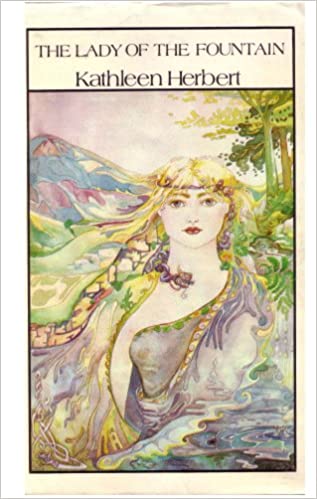
Her first novel suffered from large cuts in order to be of publishable size for a small press.  It was called Lady of the Fountain (Frome, Somerset: Bran's Head Books, 1982). It is based on the medieval Welsh Arthurian romance, Owein: Chwedyl Iarlles y Ffynnawn.  She secured publication for subsequent books with the Bodley Head in London and St. Martin's Press in New York, and these were translated into several languages. First came Queen of the Lightning (1983), followed by Ghost in the Sunlight (1986). A revised version of her first novel (with a few cut parts restored), in essence a prologue to the other two, appeared as Bride of the Spear (1989). All three novels are set in the sixth and seventh centuries in the northern kingdoms of Britain. Queen of the Lightning won the annual Historical Novel Prize given in memory of Georgette Heyer. In 1984 Herbert retired completely from teaching, and was remembered fondly as an inspirational teacher.

In the late 1980s or early 1990s, she wrote another novel, Moon in Leo, but though her publisher the Bodley Head thought it her best, they declined it for economic reasons. The manuscript languished for years. Herbert turned to writing a number of nonfiction books, on specialized historical topics, for a small press, Anglo-Saxon Books.  These book are not scholarship per se (the scholar Carole M. Cusack noted in 2011 that "Herbert aims to raise popular awareness of Anglo-Saxon and British Celtic culture, but despite her knowledge and love of the subject fails to meet academic standards of probity"). The first was Spellcraft: Old English Heroic Legends (1993); it was retitled more simply as English Heroic Legends when reissued in 2000.  Other titles include the small volumes Looking for the Lost Gods of England (1994), a transcription of a talk given to The English Companions in March 1994; and Peace-Weavers and Shield-Maidens: Women in Early English Society (1997), another talk given to the same organization in the winter of 1994-95. Some extracts from Looking for the Lost Gods of England appear under the title "The Early English" in the collection Our Englishness (2000), edited by Tony Linsell.

On 20 May 1991, Herbert gave a long and interesting interview to Raymond H. Thompson of The Camelot Project about her writings and her interests.  It can be read in full here. Here she comments on Tolkien: 
I was one of Tolkien's students, although I must admit that as far as I was concerned at that time, he was the man who lectured on Beowulf and The Fight at Finsburgh. Reading The Lord of the Rings, however, is like reading The Iliad. Just as every other epic poem seems a little bit pale by comparison, so every other fantasy novel seems to be watered-down Tolkien. He was a tremendous influence on me—linguistically, I would say, more than artistically—because of his utter integrity, his refusal to pass any word without a full consideration of its meaning and its history. Though I loved The Lord of the Rings, to me he is the editor of Finn and Hengest. That is the supreme experience for me, reading his work on that text. It opened a window into a whole period in the life of the English.
Herbert had a massive stroke in April 1994, and had a long decline physically and mentally through her remaining years. A close friend of more than four decades, Connie Jensen, founded the small press Trifolium Books in order to publish Herbert's novel Moon in Leo, set in the time of the Restoration of King Charles II in the seventeenth century. It came out in 2011. A short story found in her papers, "The Once and Future Queen," appeared as an ebook in 2013. Since 2013 Trifolium Books has announced several times the imminent republication of Bride of the Spear, with additional material and notes, but as of this writing (May 2020) it still hasn't appeared.

Another fairly large work left by Herbert (incomplete) was to have been titled Ghosts of Camelot. Herbert discussed it at the end of her 1991 Camelot Project interview referenced above. It concerned the use of the Arthurian legend in fourteenth century England, in which an Oxford scholar and poet sees a copy of the manuscript of Layamon's Brut. The main character of the novel was a skeptical Welsh girl. Herbert wrote some "50,000 words, and left lots of research notes, plot lines and incidents" according to an editor at Trifolium in 2013 who hoped to complete the work. 

Kathleen Herbert died in her sleep on 31 July 2016.

Note: This Kathleen Herbert should not be confused with the British poet Kathleen [Valerie] Herbert (1905-1996), author of Here and Now: Selected Poems 1928-1988 (1989) and other works, including her first book, No Return (1937), which was published under her maiden name, K.V. Chevis.


*I'm grateful to Kate O'Donnell, Assistant Archivist at Somerville College, Oxford, for providing information.

Sunday, May 10, 2020

James S. Wallerstein

James S. Wallerstein (b. New York City, 25 September 1910; d. Mount Kisco, NY, 28 June 1990)

James Scheuer Wallerstein was the son of  Max Wallerstein (1874-1937) and his wife, Helen (b. 1886; last traced to the early 1950s), nee Scheuer. Max Wallerstein and his brother Leo (c. 1882-1958) were from a Jewish family in Bavaria. Max studied chemistry at the University of Munich, with his Ph.D. thesis being "A Study in the Transformation of Barley Fat during Germination." By 1895 Max had emigrated to the United States and he became involved in the brewing industry. In 1902 Max and his brother Leo founded the Wallerstein Laboratories in New York, providing consultation services to the brewing industry. After a visit to England, Max published in 1907 a long study of "Notes on English Brewing" in volume 3 of the Transactions of the American Brewing Institute. Max married Helen in Tarrytown, New York, on 24 June 1909.  Besides their son James, they had a daughter Elizabeth, four years younger than James.

James S. Wallerstein attended Harvard University (A.B. Honors, 1932, with thesis "Freedom and the Self"), and Columbia University (A.M., 1938, thesis "The Development of Felix Adler's Thought in Relation to Economic Issues"). He also received a Ph.D.  He joined the Sarah S. Ollesheimer Fund, a college scholarship foundation named after his mother's aunt, in the early 1940s, and remained there until his death. He also worked as a brewmaster at the Wallerstein Laboratories in the 1940s, until the firm was sold in the 1950s. He married and raised two sons.

Wallerstein also wrote children's plays and books for young adults. It appears that most of these came out from subsidy or vanity publishers.  His first book was the novel The Demon's Mirror (New York: Harbinger House, [January] 1951). The second edition from Bellamy Press is undated, thereby causing confusion bibliographically, but according to an advertisement in Publishers' Weekly for 19 May 1951, it was published just four months after the first edition. (Many copies of the book were apparently distributed by various foundations with which Wallerstein was associated.) The Demon's Mirror is Wallerstein's primary contribution to the literature of the fantastic. The blurb on the rear of the dust-wrapper notes that the novel is condensed from an original of 1800 pages, which took Wallerstein more than thirteen years to write. The prelude opens in the ancient past with the demon Saurakin coming to the King's court and presenting a magic mirror, which makes real the thought of the person standing before it. Thus the "Horror" in the King's mind becomes real.  The scene then shifts to modern times and quickly the book becomes sprawling, attempting too many things while succeeding in none of them. The result is an eccentric and wobbly book that was clearly something its author did not know how to handle. It is not, however, without interest, but it remains fairly unsatisfying as a work of literature. 

Wallerstein's plays include The Cactus Wildcat: A One-Act Rip-Roaring Western Comedy for Children (1954), which was reprinted in Adventure: Five Plays for Youth (1945). Another collection was Over the Hills: Four Plays for Youth (1959). 

The rest of his novels were illustrated, and they include Tommy and Julie (1952), illustrated by Chester Goodwin; The Trail of Danger (1971), illustrated by Richard Giordano; and the final two, The Outer Darkness (1976) and No Traveller Returns (1987), both illustrated by Frederick J. Mackie, Jr.
The Outer Darkness is blurbed as "the Cain and Abel story in modern America. But with an unexpected ending. A tale of romance, adventure and Gothic mystery."