Thursday, September 26, 2019

David Jarrett

David Jarrett (b. Llantarnam, Monmouth, 1 March 1943; d. Porlock, Somerset, 26 August 2010)

David William Jarrett was the son of Mervyn Spencer Jarrett (1906-1986), a works engineer, and  his wife Olive Elizabeth Jenkins (1907-1997), who were married in the summer of 1940.  He had one older brother.

David grew up in Llantarnam, but was educated from 1953 at the Cathedral School in Wells.  He matriculated at Jesus College, Oxford, in October 1961 (B.A. 1964; M.A. 1969; B.Litt. 1968; and D.Phil. 1977).*

He began a long academic career in 1977 at King Alfred's College, Winchester, and in 1980 moved on to teach at the North London Polytechnic. Afterwards he taught in Poland, Saudi Arabia, and France. He settled in Porlock on his retirement.

His first book was The English Landscape Garden (1978), which was followed in 1979 by a short novel (discussed below), and then by an interesting booklet, The Gothic Form in Fiction and Its Relation to History (1980), on Gothic novels from Horace Walpole on to Faulkner, Kafka, and Iris Murdoch.

His other books include Geometry, Winding Paths, and the Mansions of Spirit: Aesthetics of Gardening in the Seventeenth and Eighteenth Centuries (1997) by David Jarrett, Tadeusz Rachwał, and Tadeusz Sławek;  and with the same two co-authors he co-edited The Most Sublime Act: Essays on the Sublime (1996), and Writing Places and Mapping Words: Readings in British Cultural Studies (1996). A final book was Packing and Unpacking Culture: Changing Models of British Studies (2001), edited and with an introduction by David Jarrett, Tomasz Kowalewski, Geoff Ridden. 

Sphere, 1979
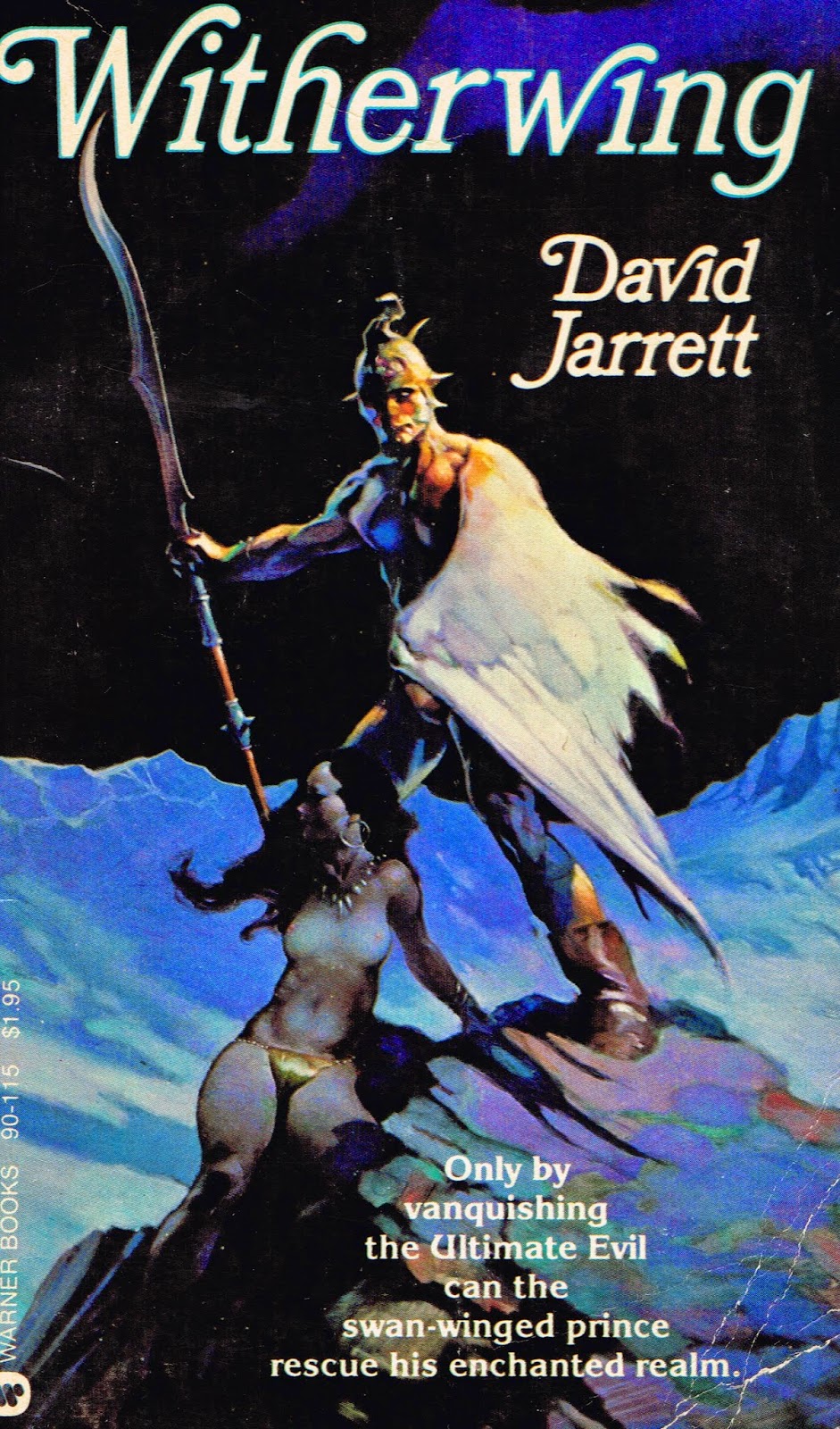
Jarrett's novel was Witherwing (London: Sphere, 1979: New York: Warner, 1979). It begins as a kind of heroic fantasy novel in which Witherwing, the youngest of six princes of Tum-Barlum (the name clearly modeled on Twm Barlwm, the name of a hill in south Wales, but that has no significance to the story). Owing to the botched end-result of some long-ago spell cast by his stepmother, the Queen of Dread, Witherwing has a swan wing instead of a left arm (this plot point echoes The Seventh Swan by Nicholas Stuart Gray, published in 1962). This short novel traces Witherwing's quest of self discovery while searching for some mysterious glowing stones used by his step-mother to perform magic. With this beginning, the book sounds almost commonplace, but it is not. Jarrett seems to be setting up a standard story of sword-and-sorcery only to undermine it.  Witherwing is aided on his quest by strange and ineffectual companions, like the mute albino boy called Hutt, and the unadventurous bald wizard Kryll who burns his books for warmth ("Literature breeds distress. Thirst for learning is thirst for power, and power is death" p. 44). The tone alternates between some wild imagery and some often amusing snarkiness. But there are also long stretches of prose that are simply uninteresting. The denouement turns the book into trite science fiction, for Witherwing meets his long-lost step-mother only to find that she is one of a bunch of magisters who for ages have played games with Witherwing's world. Some of the magisters (like Kryll the wizard, or Hrasp the marauder and murderer) enter the world to play the game. The Queen of Dread did so too, and became entirely bored in the process. Witherwing, learning this, grows angry:  "But this makes a mockery of life!" (p. 126). It does, and snark only works for so long as a literary methodology. So far as I know, Jarrett never published any further fiction.  

The US edition of Witherwing features cover art by Frank Frazetta.  Readers of the time lured in by Frazetta's cover were led to expect standard genre fair, and were doubtless disappointed. 
Warner, 1979. Art by Frank Frazetta.
Thanks to Dr. Robin Darwall-Smith, Archivist of Jesus College, Oxford, for details of David Jarrett's academic career.

Monday, September 23, 2019

Robert Clay

Robert Clay (b. Killiney, Ireland, 19 September 1884; d. Lautoka, Fiji, 21 July 1965)

Details of Robert Clay's genealogy and life are not easy to discern, but he was born Robert Henry Keating Clay, the son of Robert Keating Clay (1835-1904), a Dublin solicitor (in turn the son of another Dublin solicitor, William Keating Clay, who died in 1894), and his wife, Florence Elizabeth Casey (d. 1897; her middle name appears in some records as Bessy or Bridget), who were married in Monkstown in south Dublin on 29 July 1862. Robert Clay was probably the youngest child of the marriage (he had six older sisters and one older brother). The recipient at probate of his father's estate on his death in 1904 was Robert's (eldest?) sister Dorothy May (Clay) Gordon; she was married to John Gordon (1849-1922), an Irish lawyer and politician who was the Member of Parliament for South Londonderry (a Parliamentary constituency that was abolished in 1922) from 1900-1916.

Little is certain about Robert Clay's education and life, but in censuses and in various government documents he listed himself as a lawyer or a writer.  By 1911 he was married to Alice Louise Clay (whose occupation was sometimes given as physician), and living in Dublin.  He and Alice apparently did not have any children, and Alice, who was very close in age to Robert, may have lived into the 1950s.

Robert served in the Royal Army Service Corps in World War I. After the war, he and his wife were based for a short time in Stroud, Gloucestershire, though they traveled to New York and to western Canada.  By the early-1920s they had settled in West Vancouver, British Columbia, and later in Sooke, on the southern tip of Vancouver Island, where Robert and Alice were known to be living as late as in 1949.  The next reference point for Robert is his death in Fiji in 1965.

Robert Clay's writing career seems confined to the 1920s. As a byline he seems always to have used "Robert Clay," but in personal life he and his wife often used the surname "Keating-Clay."  His first known story. "The Man Who Hated Worms," appeared in The Black Mask for April 1, 1923. Three other short stories are known:  "The Voice and Simon Eld" appeared in Young's Realistic Stories Magazine, September 1923; "The House without a Mirror" in Hutchinson's Magazine, June 1924; and "Ordeal" in Hutchinson's Adventure-Story Magazine, January 1927.

His first novel, A Chequer-Board, was serialized in seven parts in Blackwood's Magazine from November 1925 through May 1926. It is a romance of pirates, in the manner of Rafael Sabatini.  It appeared in book-form from William Blackwood and Sons (Edinburgh) in November 1926; with a US edition from J.B. Lippincott in 1927. An undated reprint by A.L. Burt, retitled The Romance of a Pirate, probably came out in 1928.
The Lippincott 1927 dust-wrapper

Clay's second novel, By Night (Edinburgh: William Blackwood & Sons, [March] 1927; Philadelphia: J.B. Lippincott, [August] 1927), is sometimes describes as a horror thriller, but it is not supernatural. Here Neil Gascoigne inherits from his uncle the home where he grew up. His ownership is complicated in that he is forced to keep employing the mysterious Japanese gardener Kito, and he must keep residence for a fixed period.  The latter isn't a problem, for renting a house on the estate is the family he was close with as a youth.  It includes sensible Jean Raeburn, who provides the love interest of the story. But there are hints of a haunting, and a motorcylist is found dead, possibly murdered, and soon afterwards a tramp is definitely murdered. Some guests see a horrific monster and are convinced of its supernatural nature.  The story plods on—it is only moderately engaging—until in a fell swoop the solution is revealed. The mad uncle had faked his death and made (literally) a horrific black rubber suit for no other purpose than to randomly kill and terrorize. Thus the denouement is preposterously silly and unsatisfying. Yet the book is collectible for its very attractive dust-wrapper illustration.

Clay's third and final novel, Carmen Sheila, came out from the same publishers in the UK (October 1928) and the US (January 1929). It is set in a small South American republic where Carmen Shiela, along with some close friends, have gone to search for her beloved brother.

Friday, August 23, 2019

Donald Armour

Donald Armour (b. London, 23 May 1908; d. Hindhead, Surrey, 2 July 1988)

Donald Armour was the son of Donald John Armour (1869-1933), an eminent Canadian-born brain surgeon, educated in Toronto (M.B. 1891) and at the University of London (M.B. 1894; L.R.C.P 1896; M.R.C.P. and M.R.C.S. 1897), where he also taught for a time, and his wife [Marie] Louise Clark Mitchel (1873-1954), who were married in Cobourg, Ontario, on 2 October 1901.  Donald had two older sisters. Armour and his family were Catholics.

Donald was educated at Ladycross Preparatory School, Seaford, and the Downside School, Somerset. He matriculated at Pembroke College, Cambridge, in October 1926 (B.A. December 1929). He married Mary Consuelo Hutton (1908-2007) in Marylebone, London, on 17 November 1932. They had one son and one daughter.
 
Armour worked as an advertising copywriter in London through the 1930s, served in the Royal Corps of Signals from 1939-1945, and managed an advertising agency in Cape Town, South Africa, from 1947 through 1959.  From 1960 through 1972, he worked in Alicante, Spain, returning to England and settling in Devonshire from 1972 to 1986, before moving at last to Hindhead, Surrey, two years before his death.

Armour published two novels, the first short and the second much longer. The first, Swept and Garnished (London: Laidlaw Books, [October] 1938), came from a very short-lived publishing firm, who had also planned to publish in 1939 Armour's second novel, So Fast He Ran (London: Chapman and Hall, [May] 1940), but went out of business before doing so, and the book was passed on to another publisher. Both novels are fantastical in nature.

Swept and Garnished has been championed as a lost masterpiece, but that somewhat overstates its value. The simple plot successfully circumscribes the happenings between two clergyman rivals in a small town in the West Country, one a more modern Anglican vicar, the other a more traditional Catholic priest. The devil finds an inroad via the vicar and his family, and it is the Catholic priest who realizes that something truly evil is happening and must work to thwart it.

So Fast He Ran is a considerably more ambitious work. It is a time-slip novel, in which a man in the present escapes danger by successive transportations into similarly fraught situations in the past, first to the time of King Arthur, then to the time of Boudicca, and still further back to a Neolithic time.

These two novels are apparently Armour's only published fiction. It is a pity that Armour turned away from literature.

Wednesday, August 21, 2019

Ledyard M. Bailey

Ledyard M. Bailey (b. Painesville, Ohio, 22 June 1862; d. Ridgewood, New Jersey, 19 November 1938)

Ledyard M. Bailey contributed one single novelette to Weird Tales, "The Cobra Lily" in the January 1924 issue. Sadly, it is not a very good story, and it is more an adventure romance than a weird tale. It concerns a sacred flower used in serpent worship in the Yucatan, and some members of the cult. The plot is filled with cliches and the story weak and of little interest. Bailey contributed over a dozen stories to magazines in the 1920s, ranging from 1924 through 1928, in titles such as The Blue Book Magazine, Popular Magazine, McClure's and Women's Home Companion. Bailey published no books, and few of his stories have been reprinted.

Ledyard Marlborough Bailey was the son of Nathaniel D. Bailey. He graduated from Western Reserve College in Ohio (now Case Western Reserve), later settling in Utah. Around 1892 he married Anne Austin (1866-1935). They had two daughters, the younger of which died as an infant. He managed the Portland Cement company in Salt Lake City for many years. He also served as executive secretary of the Utah Food and Fuel supply organization during the World War. After his retirement, Bailey moved to southern California. He was visiting his daughter in New Jersey when he died.


Tuesday, July 2, 2019

Gilbert Wakefield

Gilbert Wakefield (b. Sandgate, Kent, 23 April 1892; d. London, 4 July 1963)

Gilbert Edward Wakefield was the youngest son of the Reverend Henry Russell Wakefield (1854-1933), after 1911, the Bishop of Birmingham, and his wife Frances Sophia, nee Dallaway (1856-1919), Gilbert had one sister and two brothers, one of whom was H. Russell Wakefield (1888-1964), the ghost story writer. His father also published a number of books and pamphlets on religious topics.

Gilbert was educated at Harrow, and at University College, Oxford. He served in the war, and was wounded in France, and afterwards worked in the Intelligence Department at the War Office. In 1919 he was called to the bar and became a barrister for nearly ten years, though his interests clearly lay with the theatre. In 1920 he married the stage and (later) film actress Isabel Jeans (1891-1985). Jeans had previously been married to actor Claude Rains from 1913-1915. The couple had no children.

Gilbert authored a number of plays (see the list, current up to 1938, at right). Only one of the plays appeared in book form, Room for Two (1938), and it constitutes Gilbert's only book. It is a farce about a female impersonator. Gilbert's best known work was probably the play "Counsel's Opinion", first produced in 1931. It was made into a film of the same title in 1933 (now considered a lost film), and remade as The Divorce of Lady X (1938), starring Laurence Olivier in the lead role. As a 1930s romantic comedy, it is well-done. A remake as Counsel's Opinon came out in 1949. Another of Gilbert's plays, Room for Two, was filmed in 1940.

Gilbert had been the dramatic critic for the Saturday Review from 1930-1932.  He also worked for a while with London Film Productions as a scenario writer. In person, he was self-deprecating, and having rebelled against his church-upbringing, he held a respect for truth and a contempt for sham. Often in ill-health, he died in hospital at the age of 71. 


Friday, June 28, 2019

Helen Oakley

Helen Oakley (b. New York, New York, 10 February 1906; d. Manhasset, New York, 4 January 2003)

Helen Fairchild McElvey was the middle of three children of Ralph Huntington McElvey (1877-1957), an artist, and Helen A. Fairchild (1879-1964), who were married on 15 July 1903.  Helen had two brothers.

Helen graduated from Bryn Mawr College in 1928. She founded a bookshop in New York City in 1929, and ran it for twelve years. Helen married Walter T. Oakley (1913-2000), who worked in publishing, on 6 August 1938. She and her husband settled in Manhasset on Long Island. They had two daughters. Later she taught art and creative writing classes and worked as a library assistant. 
Helen Oakley

As Helen Oakley, she published four books of fiction for young girls:  The Horse on the Hill (1957); The Ranch by the Sea (1959); The Enchanter's Wheel (1962); and Freedom's Daughter (1968). She also compiled a small monograph, An Alphabet of Christmas Words (1966), as selected by Helen McKelvey Oakley.

Walter Oakley
As Helen McK. Oakley she wrote a booklet Christopher Morley on Long Island (1967), about the once well-known author Christopher Morley (1890-1957) who had lived for many years in nearby Roslyn, Long Island. Oakley became greatly interested in Morley, and wrote the only (to-date) full-length biography of him, Three Hours for Lunch: The Life and Times of Christopher Morley (1976).  It was published by Watermill Publishers, a short-lived firm run by Arthur Coleman that published a half dozen books between 1973 and 1979, four of them written by Coleman himself. Three Hours for Lunch is Oakley's most significant book.

Oakley died in Manhasset about one month shy of her 97th birthday. 

Tuesday, June 25, 2019

Maggie-Owen Wadelton

Maggie-Owen Wadelton (b. Roscommon, Ireland, 24 January 1894?; d. Indianapolis, Indiana, 4 February 1972)

Maggie-Owen Wadelton published four books in the 1940s. Three are autobiographical, and the fourth is a supernatural novel. The autobiographical books are very problemmatic because none of the details of Wadelton's early life, and the names of her relations, as given in the three books, can be confirmed through genealogical resources like censuses and birth and marriage records. And in fact Wadelton in the mid-1940s gave conflicting information to two biographical references, including Who's Who (1944 supplement) and Catholic Authors (1948). Even bibliographically there are problems with her works, including two supposedly published books which do not seem to exist.

Her first autobiographical book was The Book of Maggie Owen (1941), which was evidently based upon (yet revised from) some diaries of her childhood in Ireland that had recently come back into her possession (after the death of her great aunt in Ireland). The book gives no author name other than Maggie Owen, and it begins on her supposed twelfth birthday of 24 January 1908. The second volume, Maggie No Doubt (1943), as by Maggie-Owen Wadelton (the same byline as her two subsequent books), and it covers her time in Ireland, America, England and France up to her third marriage in June 1917 to an American reserve captain in World War I. After 1917, Maggie-Owen's life is fairly well documented, and this time period is also covered in her third autobiography (and final book) Gay, Wild and Free: From Captain's Wife to Colonel's Lady (1949).

Maggie-Owen's story, as can be pieced together from the first two autobiographies, is that her young mother (married at age fourteen) had died as Maggie-Owen was born, and her father, who was the seventh child of a family that had moved to America and left him behind in Ireland, abandoned the baby girl with her mother's family and soon afterwards perished in battle in Africa or India. Maggie-Owen was raised mostly by two great-aunts, and some of their other relations. After a trip to New York where she met some of her father's family, they petitioned the Irish court for custody of the minor Maggie-Owen to be given to them, and a plot was hatched that a sham-marriage for Maggie-Owen took place in France with a gentleman temporarily unable to marry the woman he loved. The “marriage” was annulled after some twenty-two months, when Maggie-Owen reached the age of eighteen. Her second marriage, probably in the summer of 1915, was to her childhood love Edward, who was killed in the war three weeks later.

Tommy Wadelton
Maggie-Owen Wadelton and her third husband Thomas Dorrington Wadelton, Jr. (1886-1945) had one child, a son, Thomas Dorrington Wadelton III (1925*-1974), who after publishing two short stories was courted by publishers, and thereafter produced four books (as by Tommy Wadelton) in the early 1940s when he was very young. These include humorous portrayals of his mother and father, respectively, in My Mother Is a Violent Woman (1940) and My Father Is a Quiet Man (1941), and of himself, in Army Brat (1943), which was made into a film as Little Mister Jim (1946). A final book was Silver Buckles on His Knee (1945). Tommy went on to study photography and worked as feature photographer at the Indianapolis Star for more than twenty-two years. When Colonel Wadelton retired from the army in 1939, after some twenty moves to various postings, the family settled in Indianapolis.

Maggie-Owen's birthname, birthyear, and parentage is uncertain. From The Book of Maggie Own, it would seem that she was born in 1896, but in other places the year is given as 1895, 1894, or even (in the Social Security Death Index) as 1890. She told Catholic Authors in 1948 that her birthname was “Margret [sic] Kearns” but she gives it in The Book of Maggie Owen as “Margret Owen” and in Maggie No Doubt as “Margret-Owen Coughlin.” Her parent's names are given variously as Maggie-Kate Melody and Owen Coughlin (in Maggie No Doubt) and on her 1972 Indiana death certificate as Maggieowen O'Malley Kierns and Phenis Paul Kierns (the informant being her son Tommy, but here her birthdate is listed as 23 January rather than the usual 24 January). Her father's family in America appear in The Book of Maggie Owen as the Coughlins. Some Kearns relations of Van Etten (New York?) appear actually to have been of Rhinebeck, New York, where in the 1940s and 1950s Maggie-Owen visited the Mistresses Mary Kearns and Catherine Kearns, who are called in contemporary newspaper accounts her “sisters.” (And Mary Ellen Kearns is the dedicatee of Maggie no Doubt.)

Her first husband's name is given in Maggie No Doubt as Ernest Ruthven Kenmore, but in the 1944 Who's Who as Ernest Leslie Kenmore. Her second husband appears as Edward Bootham Turner-Holt. Her great aunts as Ann (Melody) Conner, and her sister Kate Melody, elsewhere Kate Holt Melody. In the 1920 and 1930 US Censuses, Maggie-Owen's name is given as “Jeanne K. Wadelton.” Yet in a letter to the Indianapolis Star in 1940 she signed her name as "Maggie-Jeanne Wadelton."

All these discrepancies are confusing. One can presume that her birthname was probably Margret Jeanne Kearns. (A 1941 newspaper profile notes that the "Owen" is a Gaelic form of Eugenia, which perhaps explains her evolving nickname Maggie-Jeanne / Maggie-Owen.) She also claimed to have used for some years the surname of her great aunt, named as Kate Melody in her autobiographies. 

Her Who's Who entry lists her education at the Sacred Heart Convent, Paris, 1909-1911, and at Carshallton House in Surrey for 1911-1912. She also volunteered as a member of the British Ambulance Service in World War I.

Catholic Authors notes that “under the name of Melody she wrote Sheila and Ponobscot Ferry.” I can find no trace of any such publications. In a 3 October 1943 Indianapolis Star newspaper profile, she reportedly began writing after the stock market crash of 1929, and sold verse to Poetry, a lengthy article on the history of lace to a New York department store, and various short stories to pulp magazines. In the newspaper profile Wadelton notes: “Then I wrote a novel, which is probably the worst book ever written. It is full of rape and murder and everything terrible. I called it 'Sheila.' Scribner's published it--though I don't see why.” None of these publications have been traced. She did write at least one other novel, finished in the summer of 1947, titled Gillian Benedict, about an alcoholic woman in London between the wars. It was turned down by Bobbs-Merrill, who had published her other books.

Her one known and published novel Sarah Mandrake (Indianapolis: Bobbs-Merrill, [February] 1946) is the work that concerns us here. Sarah Mandrake has restored a large mansion on the Hudson River in Dutchess County, New York (the setting is based on the house Wadelton visited as a child, as described in her first autobiography). After living there for a while, she disappears, leaving the house to a relative, Stephen Ellers, a British war veteran with his wife and infants, who must unravel the story of her life and of her legacy. The Catholic World called the book a “fascinating, red-blooded ghost-story 'in modern dress'” (July 1946); while Kirkus called it “with deliberate British formality,a sometimes overplayed, overlong tale of evil and retribution, real and spectral, to satisfy some tastes” (January 1946). Sarah Mandrake was reprinted in 1966 as a Paperback Library Gothic.

Both Maggie-Owen Wadelton and her husband are buried in the Arlington National Cemetery, in Arlington, Virginia, across the Potomac River from Washington, D.C.


* Tommy's birthyear is usually given as 1926 or 1927, but U.K. Birth records confirm he was born in 1925.